
Desk: Economic, Business & Financial
Byline: Dakota Jones
Google Burned $9 Billion in Cash in One Quarter and Wall Street Still Said "Not Good Enough"

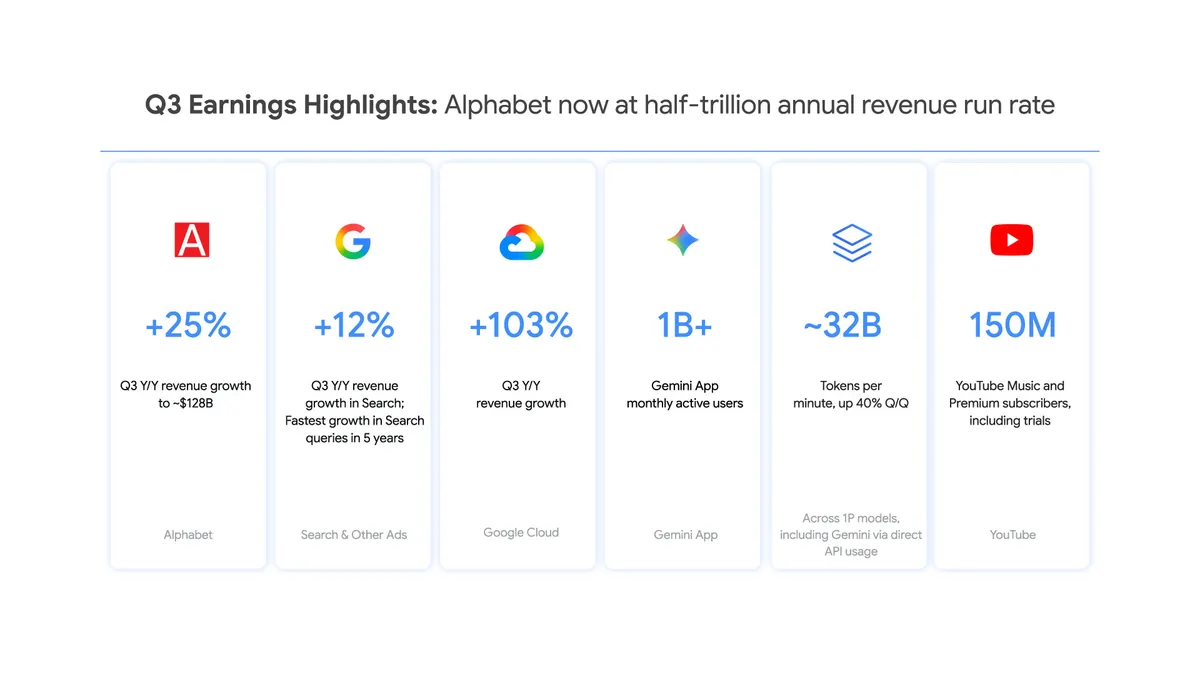
Alphabet’s latest results delivered the sort of numbers companies usually parade around: revenue up 25%, Google Cloud up 103%, and an annual revenue run rate of half a trillion dollars. Then came the cash-flow line. In the third quarter, free cash flow turned negative $9.07 billion.
Investors noticed. Alphabet shares fell about 10% after the results and in premarket trading Thursday, putting the stock on course for its worst post-earnings drop ever. The message from Wall Street was not that Alphabet has stopped growing. It was that growth, especially when powered by enormous AI spending, needs to show up in the cash register too.
What happened
Alphabet, Google’s parent company, reported third-quarter results after the bell on October 28. Revenue reached $127.58 billion, up 25% year over year, according to the company’s earnings remarks from CEO Sundar Pichai. Pichai said that puts Alphabet at a half-trillion-dollar annual revenue run rate.
The headline tension was in free cash flow. That’s operating cash flow minus capital expenditures: a useful measure of how much cash a company has left after spending on major assets. Alphabet reported $42.29 billion in operating cash flow and $51.36 billion in capital expenditures for the quarter. The result: negative free cash flow of $9.07 billion, well below analysts’ expected negative $2.70 billion, according to CNBC.
That is not the same as Alphabet reporting an operating loss. It means capital spending outpaced cash generated from operations during the quarter. The distinction matters. So does the size of the gap.
Alphabet maintained its full-year capital expenditure guidance of $195 billion to $205 billion. In plain English: the company is not signaling that the AI buildout is about to become a modest side project.

The operating picture was not uniformly grim. Google Cloud revenue grew 103%, according to Alphabet. Search and other advertising revenue rose 12% to $63.35 billion: strong growth, but still short of analysts’ expectations.
Alphabet Chief Business Officer Philipp Schindler pointed to lower monetization in AI Mode as one factor in Search’s performance. The company is expanding advertising in AI Overviews and AI Mode, including in international markets. That is a crucial test: new AI search experiences may attract users, but Alphabet still has to prove it can make money from them at scale.
Why it matters
For investors, the question is shifting from “Is Alphabet growing?” to “Are its AI investments producing returns fast enough to justify their cost?” The quarter offered evidence for both sides.
Cloud growth suggests strong demand for Alphabet’s AI infrastructure and services. But the cash-flow result shows the investment has an immediate price, while the return is less settled. Investors are weighing today’s spending against future revenue, and markets are famously impatient with “trust us, it’ll pay off later” when the invoice is already here.
The Search business adds another complication. Advertising is still growing, but the miss matters because Search remains a core source of revenue. AI Mode could reshape how people use Google. It could also change how ads fit into those searches. Alphabet is working to scale ads in the new formats; the quarter showed that monetization remains a work in progress.
Microsoft provided investors with a useful comparison. Its third-quarter capital expenditures and finance leases totaled $45.2 billion: up 30% year over year, but below analysts’ projection of $50.67 billion. Microsoft’s free cash flow fell 27% to $18.63 billion, yet remained positive. Its shares rose nearly 3% to 4% after earnings, while Alphabet’s fell about 10%.
The comparison is not a perfect like-for-like match: the reported spending measures differ. But investor reaction made one point clear. The market is not simply punishing AI spending. It is scrutinizing the cash flow, expectations, and explanation that come with it.
Ben Barringer, global head of technology research at Quilter Cheviot, described Alphabet’s results as “a fairly messy set of results and a poorly handled earnings call.” He also said Google faces “an innovator’s dilemma,” arguing that it has “lost its edge with Gemini and is behind peers on agentic AI.”
That is an analyst’s assessment, not a settled verdict on Google’s AI position. But it captures the concern: Alphabet is trying to protect a highly profitable Search business while changing the product that supports it. Innovation is expensive. Disruption from someone else tends to be more expensive.
The market backdrop was already sensitive to technology spending. Early Thursday, Nasdaq-100 futures were down more than 1%, while Dow futures rose and S&P 500 and Nasdaq futures fell, according to CNBC and Euronews. The Federal Reserve held rates steady on Wednesday, but Alphabet’s report supplied a more immediate focus for technology investors: how much cash the AI race is consuming.
Quick answers
Did Alphabet lose $9 billion?
Not as an operating loss. It reported negative $9.07 billion in free cash flow for the quarter, as capital expenditures exceeded operating cash flow.
Was the quarter weak across the board?
No. Revenue rose 25%, and Google Cloud revenue grew 103%. Search advertising grew too, but missed analyst expectations.
Why did Microsoft’s shares rise while Alphabet’s fell?
Microsoft’s spending was below analysts’ projection, and its free cash flow remained positive. Alphabet’s was negative and significantly worse than expected.
Verdict
Alphabet’s quarter was strong on growth and uncomfortable on cash. The company is expanding Cloud rapidly, investing heavily in AI infrastructure, and adapting Search advertising to new formats. Those are substantial moves, not a small renovation of the corporate break room.
But investors want proof that the spending can translate into durable returns. With free cash flow negative and Search advertising missing expectations, Alphabet did not provide enough reassurance this quarter. The market’s reaction was harsh, but the underlying question is straightforward: Can Alphabet build the next generation of AI products without weakening the cash engine that funds them?
That answer will matter well beyond Mountain View. For more reporting, follow the LD3 Productions Newsdesk.
Sources
- CNBC: “Alphabet stock drops 10% while Microsoft rises after earnings,” Arjun Kharpal, October 29, 2026
- Euronews (with AP): “Shares and US futures mixed after Google parent Alphabet’s earnings disappoint,” Angela Barnes, October 29, 2026
- Alphabet/Google: Q3 2026 earnings call remarks from CEO Sundar Pichai, October 28, 2026
- Alphabet Q3 2026 earnings release