
Two Sullivans, One Lawsuit: The Justice Department Wants a Say Before Alaska Counts a Single Vote

By Dakota Jones
Political & Government, Campaigns & Elections | October 24, 2026
LD3 Productions Daily Newsdesk, First Edition
The Justice Department has sued Alaska over a Senate race involving two candidates named Sullivan. It wants a federal judge to block certification of the result if incumbent Republican Sen. Dan S. Sullivan loses, and if a hypothetical reallocation of votes would have changed the outcome.
President Donald Trump says he directed the department to file the lawsuit.
There is one important clarification before we go any further: Alaska’s election is already underway. Early voting has begun. So the headline’s “before a single vote” means before the election result is counted and certified, not before voters have cast ballots. Those are different things. In an election dispute, the distinction matters.
The case is unusual. The requested remedy is conditional. And the legal fight arrives while Alaskans are voting, not after the state has finished counting and announced a winner.
Here is what the lawsuit asks for, what the two candidates’ names have to do with it, and what remains undecided.

What the Justice Department is asking the court to do
Pull up a chair, because the federal government just filed a lawsuit about two men with the same last name. Not a typo. Not a satirical headline generator on the fritz. The actual Justice Department of the United States, in court, over a name collision.
The DOJ filed suit against Alaska on October 22 in U.S. District Court. It argues that the presence of a second candidate named Daniel J. Sullivan could confuse voters who intend to support Sen. Dan S. Sullivan.
The department is asking the court to prevent Alaska from certifying the Senate election result if two conditions are met:
- Sen. Dan S. Sullivan loses the election.
- If votes cast for Daniel J. Sullivan had instead been cast for the senator, and Alaska’s ranked-choice voting process then played out accordingly, the senator would have won.
The proposed order would also bar certification while officials investigate whether votes for Daniel J. Sullivan were actually intended for the incumbent.
That is narrower than asking the court to remove Daniel J. Sullivan from the ballot or simply declare Sen. Sullivan the winner. It is still a consequential request: the DOJ wants a federal court to intervene in the state’s certification process under a specific, hypothetical election scenario.
And there is no completed result to test that scenario against yet. Early voting is underway, and the November 3 general election has not taken place.
Two candidates. Two ballot labels. One name dispute.
Sen. Dan S. Sullivan is the Republican incumbent. His name appears on the ballot as “Dan S. Sullivan,” with “registered Republican” and “incumbent” listed alongside it.
Daniel J. Sullivan Jr. is a separate candidate, with no relation to the senator. He appears as “Daniel J. Sullivan Jr.” without a party affiliation beside his name. He is a private candidate, not a member of the incumbent’s family or campaign.
Those distinctions are central to the disagreement. The DOJ argues that the names may confuse some voters. Alaska officials and other critics of the lawsuit point to the labels that distinguish the candidates on the ballot.
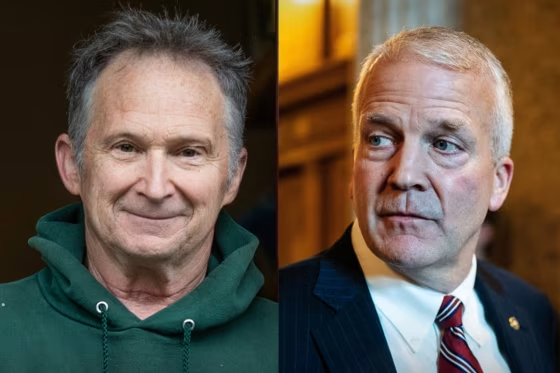
Photo via NBC News; credited there to AP and Getty Images.
The names are similar. They are not identical. The question of whether that similarity will confuse voters, or affect the result, is being argued before voters have finished voting. That timing is the part that makes this case stand out.
A lawsuit about a possible election result is arriving before there is an election result. American legal procedure does occasionally get ahead of the calendar. This is one of those moments.
Alaska’s Division of Elections, to its credit, responded by saying it is busy running the election — you know, the thing that’s actually happening right now — and that it wants voters to feel confident their votes will count. Which is what everyone claims to want. The difference is that one side is doing it.
The DOJ’s legal argument, in plain English
The department invokes the National Voter Registration Act, or NVRA. The law includes a provision that identifies election integrity as one of its purposes. The DOJ says certifying a result potentially affected by voter confusion would violate that duty.
Put simply, the department’s argument is that officials should not certify a result if votes intended for the incumbent were mistakenly cast for the other Sullivan and that difference would change who wins.
That is the department’s legal theory, not a court ruling. A judge has not, in the reports available as of October 24, decided that the NVRA gives the DOJ the authority it is asserting here, or that the alleged confusion exists, or that any votes were misdirected.
Sit with the sequence for a second: the federal government wants a court to be ready to investigate voter confusion about two candidates, while the voters are still voting. It is pre-litigating a “what if.” Somewhere, a civics teacher just felt a chill and doesn't know why.
There is also a technical complication. Alaska uses ranked-choice voting in the general election. Under that system, voters rank candidates, and ballots are counted in rounds if no candidate wins outright under the rules. The DOJ’s request asks the court to consider a counterfactual: what would the result have been if votes for Daniel J. Sullivan had instead gone to Sen. Sullivan, with the ranked-choice process then run accordingly?
That is not the same as simply adding two totals together and declaring a winner. It would require working through how the hypothetical ballot changes interact with Alaska’s voting system. The election has not happened, and the hypothetical calculation cannot yet be made.
Why this dispute did not begin with the federal lawsuit
The candidate-name controversy has been playing out in Alaska for months.
Daniel J. Sullivan’s place on the ballot was challenged by state election officials. He was initially removed, but Alaska courts ruled that he could remain in the race. The state’s decision to keep him on the ballot means both candidates are listed for the November Senate election.
The primary results also show that Daniel J. Sullivan is not a hypothetical entry with no electoral history. In August, he finished third in Alaska’s all-party primary with 2.5% of the vote. Mary Peltola received 49.5%, and Sen. Dan S. Sullivan received 41.4%.
Those are primary figures, not the general-election result. They do not establish how voters will behave in November, and they do not prove that votes will be confused or transferred from one candidate to another. They are relevant background, not a forecast.
Election snapshot
| Detail | Reported information |
|---|---|
| DOJ lawsuit filed | October 22, 2026 |
| General election | November 3, 2026 |
| Incumbent | Sen. Dan S. Sullivan, Republican |
| Other candidate | Daniel J. Sullivan Jr., unaffiliated on the ballot |
| DOJ request | Conditional halt to certification and investigation |
| Primary result for Daniel J. Sullivan | 2.5% |
The table is a snapshot of reported facts. It is not an election result or a prediction.
Trump’s role, and the criticism
The lawsuit was filed by the Justice Department at Trump’s direction. Trump said publicly that he ordered the filing. That point is not in dispute; it is part of the story.
The administration says the suit is intended to protect election integrity. A DOJ spokesperson told NBC News that the department believes the candidacy was intended to mislead voters and compromise the fairness of the ballot.
And that accusation comes with a wrinkle worth underlining: the ballot already distinguishes the candidates. Same state. Same ballot. “Dan S. Sullivan, registered Republican, incumbent” versus “Daniel J. Sullivan Jr.,” no party listed. If that is insufficient protection for democracy, the three-tenths-of-a-mile-per-hour difference between two similar names is doing more damage than anyone thought possible.
That is the administration’s allegation. Daniel J. Sullivan has denied that his candidacy is a sham, and he has said he is entitled to run for office. The allegation should not be treated as an established fact. Being named in a political dispute does not prove a private candidate’s motives.
The reaction to the lawsuit has been sharply critical. Alaska Sen. Lisa Murkowski called it unnecessary, saying the state ballot already distinguishes the candidates. Mary Peltola, the Democratic nominee, also criticized the action. David Becker, executive director of the Center for Election Innovation & Research, described it as an unprecedented federal intervention and argued that the state, not the DOJ, has authority over certification.
Those are criticisms, not judicial findings. They reflect the debate over whether the federal government has a proper role in this particular state election dispute.
The AP has also reported skepticism about the lawsuit’s legal basis. Notre Dame law professor Derek Muller told the outlet the case may matter only in a narrow scenario and questioned whether federal law authorizes the DOJ to block certification. The court has not resolved that issue.

What happens next
The immediate question is not who won. No one has won the November 3 election yet.
The question is whether the federal court will grant the DOJ’s request, and if so, what limits it will place on the order. The lawsuit seeks a remedy that would apply only if Sen. Sullivan loses and the proposed vote-reallocation scenario would have changed the outcome. That makes the case conditional by design.
Alaska’s Division of Elections has said it is reviewing the complaint while focusing on running the ongoing election and giving voters confidence that their votes will count. It has also pointed to the state’s voter information, poll workers, and legally permitted assistance as ways to help voters understand the ballot.
For voters in Anchorage, Juneau, Petersburg, and communities across the state, the practical advice is straightforward:
- Read the full name and ballot label of the candidate you intend to support.
- Use the official Alaska voter information if you have questions about the ballot or ranked-choice voting.
- Ask a poll worker for procedural help if you need it.
- Do not assume that a lawsuit has changed the ballot or the voting process. Check official state election information for current instructions.
The lawsuit does not itself remove Daniel J. Sullivan from the ballot. It does not award the seat to Sen. Sullivan. And it does not establish that any voter has been confused. It asks the court to order a potential pause in certification under a defined set of future circumstances.
That distinction may not make the case less consequential. It does make the requested relief easier to describe accurately.
FAQ
Are the two Sullivans related?
No. Daniel J. Sullivan is a separate candidate and is not related to Sen. Dan S. Sullivan.
Has the DOJ asked to remove Daniel J. Sullivan from the ballot?
The lawsuit described by NBC News and AP focuses on certification and a possible investigation. It does not simply ask the court to remove him from the ballot.
Has Alaska counted the election?
No general-election result exists yet. Early voting is underway, and Election Day is November 3.
Does the lawsuit mean Sen. Sullivan will be declared the winner if he loses?
No. The DOJ is asking for certification to be blocked under a conditional scenario. The lawsuit does not itself decide the winner.
Has a judge ruled that the DOJ can stop Alaska from certifying the result?
No such ruling is established in the reporting available for this article as of October 24.
Why does ranked-choice voting matter here?
The DOJ’s request asks the court to consider how a hypothetical change to votes for Daniel J. Sullivan would affect the result after Alaska’s ranked-choice process. That makes the requested analysis more involved than a simple tally adjustment.
Final thoughts
The case turns on a real question, whether similar names could confuse voters, and an unusual proposed remedy: ask a federal judge to intervene in Alaska’s certification process if a particular result and hypothetical vote shift line up.
For now, the facts are clear. The Justice Department sued Alaska on October 22. Trump says he directed the suit. The department argues that the NVRA supports its request. Critics say the federal intervention is unnecessary and question the DOJ’s authority. Daniel J. Sullivan remains a separate candidate on the ballot. No general-election votes have been counted into a final result, and no court has decided the case.
A name dispute can fit on one ballot line. The legal and democratic questions around it take considerably more space. As Alaskans vote, the useful thing is to keep those questions separate: what the lawsuit alleges, what the court may decide, and what voters actually do at the ballot box.
For more from the LD3 Productions newsroom, visit our news page or learn about our production services.
Verification sources